

5 Aesthetic Awareness Activities for Kids
Published by Kindermusik
Aesthetic awareness, or the ability to observe, process, react to, and value nature and artistic expression (including sound!), plays an important role in early development.
Our reactions to sights and sounds in any environment can occur naturally, but grownups nurturing the listening skills, self-control (think: standing still to watch a hummingbird), and conversation it takes to really appreciate the beauty naturally around us, and the aesthetics we’re born to create, is critical for children.
Here’s a look at the science behind early aesthetic awareness and a few specific activities you can try…
What science says about aesthetic awareness development
Aesthetic awareness development begins in the womb as fetuses’ sensory explorations involve experiencing their mother’s rhythmic heartbeat and hearing her voice.
Once they’re born, interactions begin to play an important role. A study from the Université Grenoble Alpes revealed that shared aesthetic experiences between adult and child can begin as early as four months.
“Sensing beauty… is a widely shared experience defined as a pleasurable mental state.”
David Meary, PhD.

So, caregiver-to-child cultivation of aesthetic awareness becomes critical, even in infancy, and begins to support other areas of development.
Nurturing aesthetic awareness in all art forms can increase language development, pre-reading skills, and mathematics competencies.
Aesthetic appreciation of music is especially powerful as a social-emotional awareness tool. In fact, a study from the University of Pennsylvania found that 3-5-year-olds were able to identify emotions like happiness, sadness, calmness, and fear easily within 5-second clips. Children who were associated with chronically “unemotional” behavior had difficulty with the first three but were still able to to identify fear, supporting the belief that music is an important emotion bridging tool for all children.
The question is, if parents/caregivers are children’s first and best teachers, how can families readily and steadily engage in aesthetic awareness with children at home?
Check out these five easy ways to get started…
5 Aesthetic Awareness Activities for Kids
1. Go on a nature sound scavenger hunt.
Listen for specific sounds (birds chirping, leaves rustling, etc.). Ask your child about what’s loud, what’s quiet, what they like and don’t like, and why.
When you do, you’re covering so much more than the sound itself—you’re teaching them about mindfulness, fueling auditory processing, and so much more.
It’s all part of a healthy “sound diet” for children. Check out neuroscientist Dr. Anita Collins’ explanation of what that is below and why it’s important.
“Sound is a diet for the brain that feeds it information, and that information then helps the brain grow.”
Dr. Anita Collins, PhD
2. Read a nature- or arts-based book together.
When reading books together, ask your child to act out the sounds characters or objects make, and what scenes look like to them. For example, in the Kindermusik book I Need a Kazoot!, a furry creature goes in search of a “kazoot” and ends up exploring all sorts of silly, made-up instruments. Read the swipeable version in our free app and ask questions like “If a baboot growls like a lion, how would it sound? If a spacheek is twisty, how would you hold it and play it?”
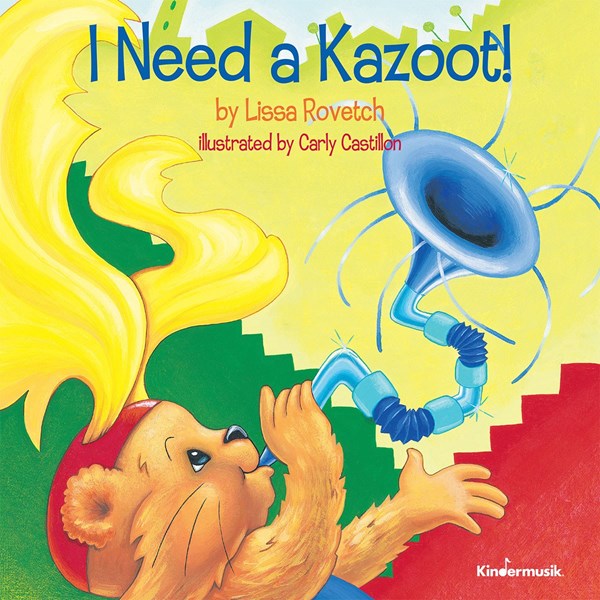
By giving them the chance to create, you’re making way for aesthetic production and laying foundations for self-confidence and critical thinking.
3. Listen to songs together and talk about what you hear.
Stream a song through your phone or car speaker (making sure that anything with a screen is out of reach or sight), and ask questions like “Is the song loud or quiet? That’s a flute…can you make a sound like a flute? How would you dance to those soft bells?”
This takes the benefits of music listening to a whole new level—you’re engaging with what you hear: exploring tempo (math!), labeling instruments (vocabulary!), and pairing emotion with movement (emotional regulation and more!).
Here’s one of our favourites, “We Are Fine Musicians.” You can also stream this one for free in our app!

4. Draw what you feel.
Keep kid-friendly art supplies within reach for those moments when inspiration strikes or big feelings take over. For example, one way to calm older toddlers’ or pre-k/kindergartners’ bodies post-meltdown is to ask them to draw what they’re feeling.
Not only does it help them express emotions in a safe way, but by tapping into multiple senses, they’re unknowingly making advanced emotional connections with colours, shapes, brushstrokes, and more.
5. Engage in group musical play.
From newborns to 7-year-olds, Kindermusik classes are the perfect way to explore instrument sounds, bright visuals, and props, interpret feelings through dance and song, and build up aesthetic appreciation as a team.
The perk for grownups—whether it comes home with you from a studio class or with your child from school or childcare experience—is that you build your aesthetic awareness development tools together.
To really boost whole-child development, it’s up to us grownups to create environments and activities that awaken and foster aesthetic senses. The best part of this tall order is that it’s easy and fun!
This article was originally authored by Theresa Case, Accredited Educator and owner of Piano Central Studios in Greenville, SC.
To learn more about building aesthetic awareness through shared music-making, join a Kindermusik class at Hamilton School of Music or check out our teaching solutions.